Introduction
Your customers expect instant, intelligent, and personalized interactions. While basic chatbots can answer simple questions, a custom conversational AI bot functions as a true digital team member. It understands context, handles complex tasks, and learns over time. This level of sophistication is becoming essential for businesses that want to improve efficiency, boost customer satisfaction, and scale their operations effectively. As highlighted in recent industry analysis, the adoption of AI in customer service continues to grow, making it a critical competitive advantage.
The hidden costs, relentless commission fees, This guide demystifies the costs involved in building a custom conversational AI solution. We will break down every factor that influences the price, from core features to the development partner you choose. By the end, you will have a clear roadmap for budgeting your project and understanding the incredible value it can bring to your business.
Understanding What Drives Conversational AI Development Cost
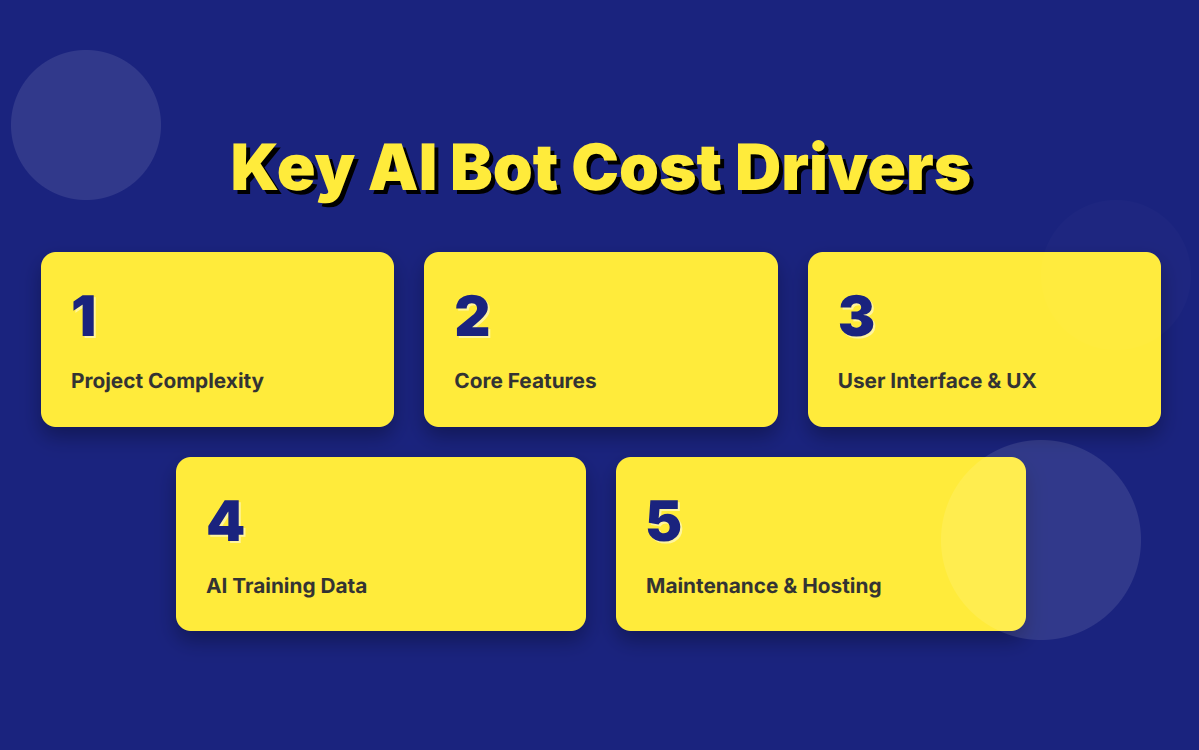
Partnering with a third-party aggregator feels The final price tag for your AI bot isn’t a single number; it’s a sum of several critical components. Understanding these drivers is the first step toward scoping a project that aligns with your budget and business goals.
1. Project Complexity & Scope
The most significant cost factor is the bot’s complexity. A simple bot and a sophisticated one are worlds apart in terms of development effort.
Simple Bots
Simple bots are typically designed to answer frequently asked questions (FAQs) or perform basic lead generation tasks. They follow linear conversation paths and support a limited number of predefined user intents.
Complex Bots
Complex bots handle multi-turn conversations, process transactions such as bookings or orders, and deliver dynamic, personalized responses. They rely on advanced intent recognition, entity extraction (e.g., dates, names), and sophisticated conversation flows. The broader the functionality, the higher the development cost.
Question: What is an “intent” in a conversational AI bot?
Answer: An intent represents the goal a user wants to achieve with their message. For example, if a user types “What are your business hours?”, the intent is “get_business_hours.” A complex bot can recognize and manage hundreds of different intents.
2. Core Features & Functionality
The specific capabilities you build into your bot directly impact the development cost. More advanced features require specialized expertise and more development hours.
Natural Language Processing (NLP/NLU): The bot’s ability to accurately understand human language, including slang and typos.
Sentiment Analysis: Gauging user emotion (e.g., frustrated, happy) to tailor responses or escalate to a human agent.
API Integrations : Connecting the bot to other software like your CRM (Salesforce), ERP (SAP), or databases to pull customer data or update records.
Proactive Engagement : Allowing the bot to initiate conversations with users based on their behavior on your website.
Multilingual Support : Each additional language adds complexity in translation, training, and cultural nuance.
3. User Interface (UI) & Experience (UX)
How users interact with your bot is another key cost consideration. A simple text box is much different from a feature-rich, voice-enabled assistant.
Interface Type: A text-based chatbot is generally less expensive to develop than a voice-based assistant. Voice AI introduces the need for Automatic Speech Recognition (ASR) and Text-to-Speech (TTS) technologies, which adds to the custom voice assistant price.
Rich Media: Incorporating elements like buttons, carousels, images, and videos creates a more engaging experience but also increases development time.
Deployment Channels : Building a bot for a single website is simpler than deploying it across multiple platforms like a mobile app, WhatsApp, Facebook Messenger, and Slack, as each may require unique adjustments.
Proactive Engagement : Allowing the bot to initiate conversations with users based on their behavior on your website.
Multilingual Support : Each additional language adds complexity in translation, training, and cultural nuance.
4. AI Training Data & Model Development
A conversational AI bot is only as smart as the data it’s trained on. This phase is crucial for ensuring accuracy and performance. The process involves collecting high-quality data, annotating it (labeling it so the AI can understand), and using it to train machine learning models. This is not a one-time task; it’s an iterative process of training, testing, and fine-tuning to continuously improve the bot’s understanding and responses.
5. Maintenance, Updates, & Hosting
Your investment doesn’t end at launch. AI is not a “set it and forget it” technology. Ongoing costs are essential for long-term success. These include:
Monitoring & Analytics: Tracking bot performance and user interactions to identify areas for improvement.
Regular Updates: Adding new features, fixing bugs, and updating the knowledge base.
Security Patches : Protecting your bot and user data from vulnerabilities.
Hosting : The cost of the cloud infrastructure (like AWS or Azure) where your bot runs.
The “Who” Behind the Build: Choosing Your Development Partner
The team you choose to build your bot will have a major impact on the final cost and quality. You have three primary options.
1. In-House Team
Hiring your own team gives you complete control. However, it comes with high recruitment costs and a long setup time. You’ll need a diverse team of AI Engineers, NLP Specialists, Data Scientists, and UX Designers, which can be expensive and difficult to assemble.
2. Freelance Developers
Freelancers offer flexibility and can have lower hourly rates. The challenge lies in managing multiple individuals, ensuring consistent quality, and avoiding scope creep. This approach often lacks the comprehensive project management needed for complex AI projects.
3. AI Development Agency
Partnering with a specialized agency like WebMob Technologies offers a balanced, reliable solution. You get access to a dedicated, pre-vetted team with established processes. This model significantly reduces your risk and often leads to a faster time-to-market. An experienced agency provides end-to-end services, from initial strategy to long-term maintenance and support.
Platform-Based vs. Custom-Built: Weighing Your Options
The team you choose to build your bot will have a major impact on the final cost and quality. You have three primary options.
1. Off-the-Shelf or Low-Code Platforms
Tools like Google Dialogflow or IBM Watson Assistant allow for quicker deployment and have a lower initial cost. They are great for simple bots and businesses without a dedicated development team. The downsides include limited customization, potential vendor lock-in, and scalability challenges for unique or complex business needs. Your bot may not have a truly distinct brand voice.
2. Fully Custom Conversational AI Development
Building from scratch with frameworks like Rasa or a proprietary solution offers complete freedom. This approach ensures the bot is a perfect fit for your unique business processes and can be seamlessly integrated with your existing systems. While it requires a higher upfront investment and longer development time, a custom build gives you full ownership, unlimited scalability, and a future-proof solution.
Specific Costs: Diving Deeper into Custom Voice Assistant Price
A common question we receive is about the custom voice assistant price. Voice AI is more complex and therefore more expensive than text-based bots. Here’s why:
Specialized Technology : It requires Automatic Speech Recognition (ASR) to convert speech to text and Text-to-Speech (TTS) to generate a natural-sounding voice.
Linguistic Nuances : Understanding spoken language, with its accents, tones, and background noise, is much harder than processing clean text.
Advanced Features : Voice biometrics for user authentication and emotion detection for sentiment analysis require specialized and costly development.
Hardware Integration : Connecting the assistant to telephony systems or smart speakers adds another layer of complexity.
Conversational AI Development Cost Ranges: What to Expect
| Bot Complexity | Estimated Cost Range | Key Features |
|---|---|---|
| Basic | $5,000 – $25,000+ | FAQ answering, simple lead capture, text-only, limited intents, fixed conversation flows. |
| Mid-Complexity | $25,000 – $100,000+ | API integrations (CRM, etc.), user authentication, transactional tasks, basic personalization. |
| Advanced | $100,000 – $500,000+ | Omnichannel deployment (web, app, voice), complex NLP, proactive engagement, machine learning-driven improvement. |
Maximizing ROI: Why Your Investment in Custom AI Pays Off
The initial conversational AI development cost is an investment that delivers substantial returns. A well-built custom AI bot drives real business value by:
Reducing Operational Costs: : Automates repetitive tasks, providing 24/7 customer service without scaling your human team.
Increasing Sales : Guides users through the sales funnel and qualifies leads around the clock.
Improving Customer Satisfaction : Provides instant, accurate answers, leading to higher loyalty and retention.
Providing Data-Driven Insights : Gathers valuable data on customer needs and pain points, informing business strategy.
Partner with an Expert AI Customer Service Company: WebMob Technologies
Navigating the complexities of AI development requires a knowledgeable partner. As a leading AI customer service company, WebMob Technologies specializes in designing, building, and deploying high-performance conversational AI solutions. Our client-centric approach focuses on understanding your unique business challenges to deliver a custom bot that provides measurable value. From initial consultation to post-deployment support, we ensure your project is a seamless and successful journey into intelligent automation.
Start Your AI Journey Today
Ready to transform your business with custom AI? Contact WebMob Technologies for a personalized consultation and expert estimate today!
Get a QuoteConclusion: Your Journey to Intelligent Automation Starts Here
The cost to build a custom conversational AI bot varies widely, but the strategic advantages are clear and significant. Understanding the key cost drivers is the first step toward planning a successful project that aligns with your vision. The right investment today can redefine your customer experience and set your business up for future growth.
Ready to discuss your custom conversational AI bot project? Contact WebMob Technologies today for a personalized consultation and estimate – let’s build your intelligent future!
Frequently Asked Questions (FAQ)
Key challenges include data privacy, hallucinations, bias, and regulatory compliance.
Q1. How long does it take to build a custom conversational AI bot?
A: A simple bot can take 4-8 weeks, a mid-complexity bot can take 3-6 months, and an advanced, enterprise-grade bot can take 6-12 months or more. The timeline depends entirely on the project’s scope and complexity.
Q2. Is a chatbot a one-time cost?
A: No. While the initial development is the largest expense, you should budget for ongoing costs for maintenance, hosting, security updates, and performance monitoring. Think of it as a subscription to continuous improvement rather than a one-time purchase.
Q3. Can a small business afford a custom AI bot?
A: Yes. Small businesses can start with a basic or mid-complexity bot that addresses their most critical needs, such as lead generation or answering common customer questions. The key is to focus on a solution that provides the highest ROI first and then scale over time.
Q4. What is the difference between a chatbot and conversational AI?
A: A basic chatbot typically follows a predefined script and can only handle simple, specific commands. Conversational AI uses advanced technologies like NLP and machine learning to understand context, handle complex conversations, and learn from interactions to become smarter over time.
Q5. How do I measure the ROI of my conversational AI bot?
A: You can measure ROI through various metrics, including reduction in customer service tickets, decrease in average handling time for human agents, increase in lead conversion rates, and improvements in customer satisfaction (CSAT) scores.
Best Practices
Use human-in-the-loop validation, secure data pipelines, and continuous monitoring.